Monday, 23 November 2009

Amelia's Anthology of Illustration

.
.
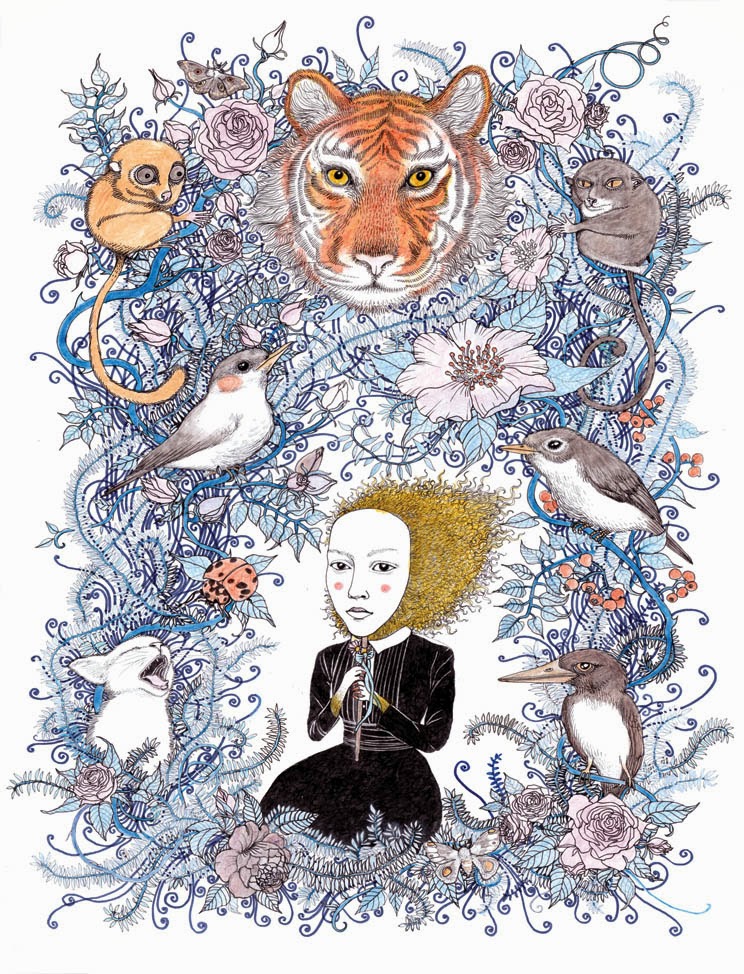
I'm very pleased to finally post this link to a lovely anthology which includes some of my best illustration work + an interview (!) This book is not only full of great images but also has an environmental theme - it's a kind of guide to renewable energy sources. Each illustrator has tackled a different technology in his/her unique way. Amelia's Anthology of Illustration is a available in a limited, hard-back edition. Have a look here for more details.

Wednesday, 4 November 2009

Flyer

.
.
A promotional flyer, made recently for Dirk Markham (WSS) and Francesca Lago.

Sunday, 18 October 2009

Colouring Book

I was recently asked to colour in this spread from my sketchbook for a publication and also to remove all parts of the sketchbook (ie the gutter and edges). Unfortunately, I didn't have access to the sketchbook in question but I have been getting more confident with Photoshop lately, so I did some cutting and pasting, using pieces from other sketchbooks and there you have it:


I always prefer to work with my hands, a pen and paper if I can help it, but I am discovering too, that Photoshop can be a fantastic tool if you know how to use it. The number of things it can do is so vast that even though I've been using it for years, I feel like I've only skimmed the surface.

Japanese Puppet


Sunday, 11 October 2009

Raum kommt von Räumen

.
.
Here is another very fine little piece of work I found in Berlin; Rita Fürstenau's booklet Raum kommt von Räumen is perhaps best described as fine art illustration. It is A6 sized and folded in on itself in a slightly labyrinthine way. Here is the cover, front and back:
.
.
You continue to unfold the pages, at different angles, until you realise that they are part of one big drawing, populated by strange animals and plants, cities and people. It's very Garden of Earthly Delights. Here is a section:
.
.
As you can see, it's very charming. I like the little jokes and references to space and folding that the artist makes throughout this landscape. Some parts remind me of Escher's prints of impossible architecture and objects.
.
.
.
I have a feeling that the title is a pun (?) of some sort, but my german isn't good enough to decode it fully. 'Raum' means space and 'Räumen' means to vacate or to clear away. So a direct translation would be: 'Space comes from evacuation' (or simply, 'space comes from making space'). Obviously, there's also a similarity between the two german words. If anyone can do a better translation, please feel free to comment.
The one thing I found disappointing was that only one side of the paper is printed on. It would have been cooler if there were images on both sides, referencing each other, but I can see how that might have been too expensive to produce.

Be sure to have a look at Rita Fürstenau's website too.


Sunday, 4 October 2009

Treasures of the Blog World

.
.
I found this blog, A Journey Around My Skull, a cornucopia of images and ephemera. Then I followed the links to other amazing blogs and now I'm lost in the woods.


Saturday, 26 September 2009

Pure Gold

.
.
The second Golden Hour book is out. For those who don't know, the Golden Hour is a monthly evening of poetry, prose, music, video and general niceness at the Forest Café. The book features some excellent work by people who have read at the Golden Hour and comes with a compilation cd of music. It's so perfectly sized and chunky you just want to hold it in your hand forever, and the cover was illustrated by you know who. The Golden Hour 2 costs £7.99. Support local talent and buy it from the Forest Shop, Blackwells in Edinburgh or Amazon UK (where it will be available soon).

Wednesday, 16 September 2009

The Arrival

.
.
I was deeply impressed with Shaun Tan's graphic novel, The Arrival. Tan is interested in the concept of belonging - and this book is about the way we come to belong to a new culture. The Arrival is a classic immigrant's tale - a man leaves his family to make a home in a new country, but the way that Tan chose to tell the story makes it unique. This new country is a strange and wonderful place, as foreign to the reader as it is to the protagonist. Its architecture, animals and food are outlandish and this lets you feel the wonder and puzzlement of a newly arrived foreigner. In addition to this, the story is completely wordless, which furthers the estrangement.
Without the help of words, Tan must concentrate on detailed and consistent storytelling through images. Here is the Man, our protagonist, on his first arrival, trying to explain himself to a customs official:
.
Tan focuses on the minuscule, deconstructing the smallest actions into whole sequences. Each tiny gesture counts. Here is how the passage of the seasons is illustrated in a whole spread:
.
.
But then, Tan will, from these detailed observations, open up a vast, breathtaking full-spread panel:
.
.
One of my favourite things about the book is the abundance of fantastical creatures. Everyone has their own, crazy little pet.
.
The Arrival demonstrates that you can take the most simple story and turn it into something rich and moving and, well, great, if you know how to tell it well.
.
.
You can read what Shaun Tan has to say about this book on his own website, which also features more of his work.