Thursday, 25 June 2009

Laika

.
One of my first comics, Laika was included in Toastycats #1. I thought I'd post it here too:
.

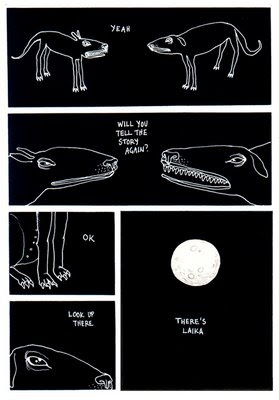
Laika, the little dog who was launched into orbit as part of the Soviet space programme, was only the first of many different animals to be put through this kind of experiment. Some have survived, many haven't. Laika died of stress and overheating a few hours in, but her vessel, Sputnik 2, was never meant to return to Earth anyway. Of course, most scientific research involving animals is less dramatic and less famous than this. Millions of animals, from fish to chimpanzees are used as test subjects every year. In this story, Laika stands as a symbol for the horrific things people do to animals in the name of science.
.
Might be worth checking out BUAV, one of the major organizations campaigning for alternatives to vivisection: http://www.buav.org/home

Southern Girl

.
Southern Girl is a really excellent blog featuring photography from the American South. Beautiful stuff. This particular picture is by John Bridges. Thanks to Mr Nick Holdstock for the tip.


Monday, 22 June 2009

The Codex Seraphinianus

.

.
The Codex Seraphinianus is a book I have never held in my hands. It is very rare and very cultish. Luigi Seraphini, an italian arthitect and industrial designer, wrote and drew the book in the seventies. It has been republished a few times in small print runs and is very expensive, factors that have contributed to its obsurity. The main factor, though, is that it is a strange and mysterious book. The Codex appears to be an encyclopaedia of an invented world, originated from that world. Meticulously illustrated and written in an invented alphabet/language, it describes the flora, fauna, architecture, culture and other features of this absurd, imaginary world. It has a feel similar to the writings of Jorge Luís Borges and the Voynich Manuscript, which seems like it could have been a direct inspiration for Serafini. I first became aware of the book through an article in The Believer and subsequently downloaded the whole book as a pdf. It's not quite the same as having the physical book, of course. I'll buy it some day.
.
Douglas R. Hofstadter writes "Some people with whom I have shared this book find it frightening or disturbing in some way. It seems to them to glorify entropy, chaos, and incomprehensibility." I think this is one of the reasons I like the Codex. Its elusiveness is as important as its beauty. It's a riddle that can't be solved.
.

.
.
.
.
.


.

Thursday, 18 June 2009

Conserving

..
These are drawings I made while looking through a book called Conserving (by Daniel and Geo Fuchs). The book features photographs of animals and humans preserved in formaldehyde.
I worked with Aquacolour Monolith pens, which are really starting to grow on me. They are quite hard and don't blend very much unless you use water, which I usually don't, and don't erase well. But as I grow more and more used to them I'm starting to appreciate their qualities. The colours are great and when you work out how to combine them they work really well together. The trick is lay down subtle layers over and over, until they mesh.
.

Sunday, 7 June 2009

Francesca Woodman

.
...
Last week I went to an exhibition of photographs by Francesca Woodman at the Ingleby Gallery in Edinburgh. I'm really glad I did because the work is wonderful.
The pictures are from between 1972 and 1981. Woodman only lived to be 22 and most of the images are the kind that a lot of teenage girls take, a kind of self-exploration through photography, but Woodman does it exceptionally well. Her photographs are meticulously arranged and often feature herself or her female friends posing in dreamlike scenarios. It's a narrative suffused with the language of death: faces are turned away, obscured or blurred, bodies disappear into their surroundings, literally merging with walls, like in this one:
..
.

.
...or here, identities displaced:

.
.

.
You can tell that Woodman loved surrealist and Victorian photography and I think probably Alice's Adventures in Wonderland too. This picture could be an illustration for it:
.

.
But this is my favourite:
.
.
My first thought on seeing this photograph, was that it presents an inversion of reality. Obviously, the animals are stuffed while Woodman is only posing. But in the frozen moment, it is the animals who appear to be alive, while Woodman seems to be dead. In this respect, photography is a remarkable equalizer.
.


Friday, 5 June 2009

Wednesday, 3 June 2009

Herzog


I enclose a link to an insightful conversation between Jason Bellamy and Ed Howard, over at The House Next Door, about Werner Herzog and his films. Well worth reading;

Tuesday, 2 June 2009

Bubble Chamber Experiments

.
.
I came across this art project while doing research for my film. A program generates the trajectories of imaginary particles - kind of like in a bubble chamber, which is an instrument used to track electrically charged particles moving through liquid. The result is a series of extraordinarily beutiful patterns. Have a look here.